
ICP
Defining who counts as a fit, so scoring, routing and campaign targeting all agree on the answer.
Your ICP is one definition, written once in the Leads Hub, that more than one system reads.
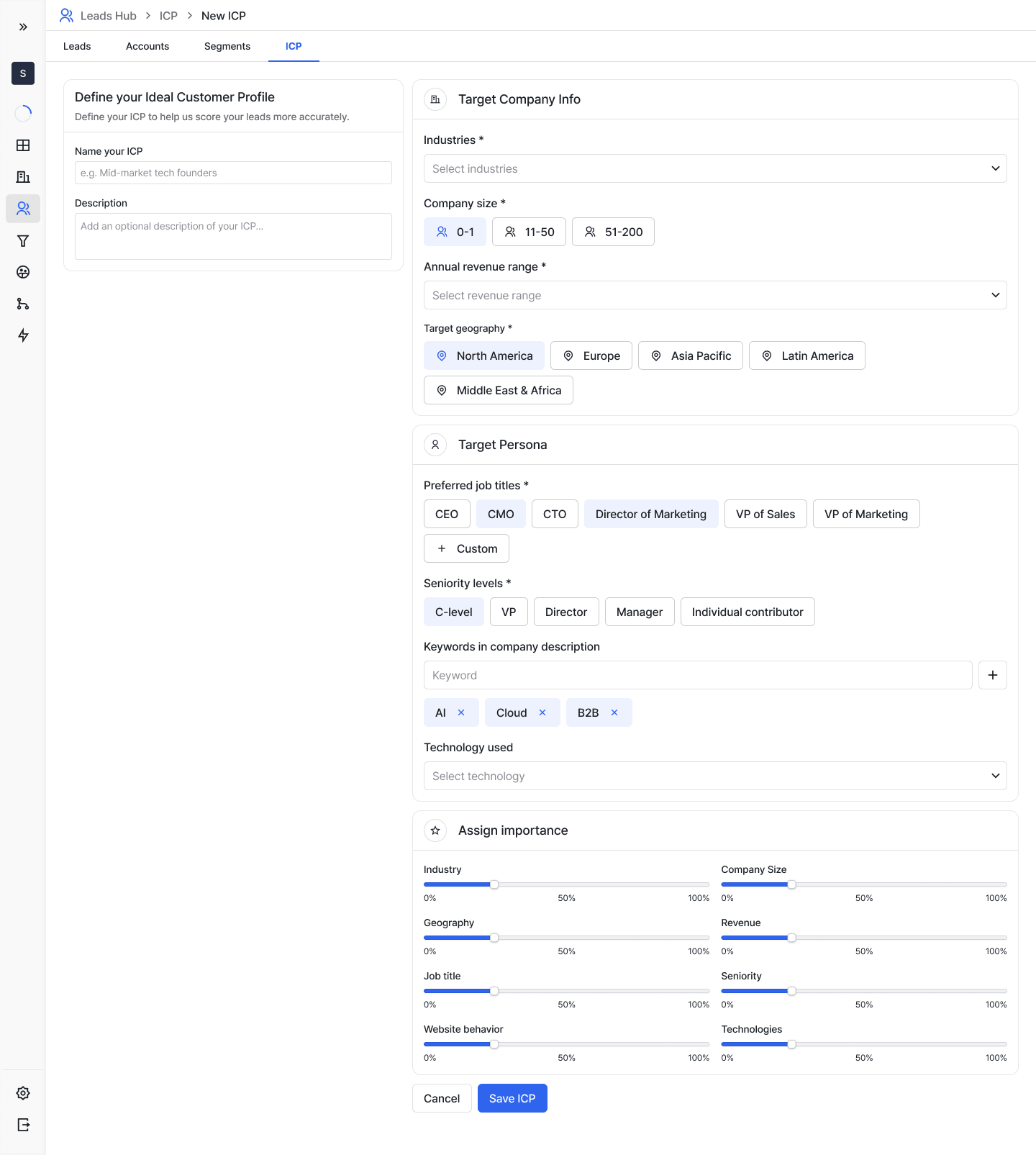
What Goes in It
| Section | Fields |
|---|---|
| Name and description | A name (you can keep more than one ICP) and an optional description |
| Target company info | Industries, company size, annual revenue range, target geography |
| Target persona | Preferred job titles (from a list, or custom), seniority levels, keywords in the company description, technology used |
| Assign importance | A weight from 0 to 100% each for industry, company size, geography, revenue, job title, seniority, website behaviour and technologies |
Industries, company size, revenue range, geography, job titles and seniority are required. The weights decide how much each dimension counts, and skipping them is why a score does not match your intuition.
Write the Exclusions down Somewhere
The builder asks who you want. It does not ask who you do not, and an ICP that only describes the good case ranks a competitor doing research above a mid-market buyer one headcount short.
Put the negative half in prose where an agent will read it: product/icp.md in
your Vault, listing the accounts you never want to
sell to and why.
Where Else It Is Read
| Reader | What it does with the ICP |
|---|---|
| Lead scoring | Fit, weighted by the importance sliders. Change the ICP and future scores move, so make it a deliberate change. |
| Routing | Surface routes on the ICP, territory and ownership rules your team already has, rather than new ones you invent here. |
| Campaign Agents | ICP definitions are one of the inputs a campaign agent reads as evidence, alongside qualified leads, opportunities and approved sources. |
The Vault copy is the same definition in prose, not a second reader. Keep the
two in step: a campaign that targets the wrong people is usually a structured
ICP that was updated and a product/icp.md that was not.
Revising It
Twice a year, driven by evidence rather than opinion:
Look at closed-won, not at the deck
Segment the accounts you won in the last two quarters. Compare that shape to the ICP you wrote.
Look at closed-lost for fit reasons
Deals lost as "not a fit" mean an ICP that is too broad, or routing that ignored it.
Change one dimension at a time
Widening industry and lowering the size floor in the same week makes it impossible to tell which change moved the score.
Tell sales before the scores move
Fit is one half of the score reps work from, so an ICP change is a conversation with them rather than a config change.
Ready to Get Started?
See it on your own site, or open the app and build the first form.
Segments
Named lists of leads, defined by a query rather than maintained by hand. The audience unit workflows, campaigns and routing all target.
Directory
Every connector Surface ships today, across CRM, communication, scheduling, automation, ads, analytics and enrichment, and where each one is documented.