
Friday Bite: July 24th Marketing Touchpoint
The first governance meeting for a marketing agent often begins after the prototype works. A channel lead has connected an ad account, a marketer has connected the CRM, and the assistant can produce a plausible weekly analysis. Then someone asks which credential it uses, what customer data the vendor retains, or who approved the definition of qualified pipeline.
Those questions are not paperwork around the workflow. They describe the workflow. An agent combines a model, instructions, connected tools, business data, and authority. Marketing owns only part of that system, even when marketing is the only team using the output.
Marketing agent governance is the set of roles, permissions, evaluations, approval rules, logs, and incident procedures that keep the system accountable. It should scale with the action. An assistant summarizing public research needs lighter controls than an agent that can change bids or lifecycle stages.
Start with an authority map
List every tool the agent can discover, every object it can read, every action it can request, and the identity behind the request. Then map the person who owns each decision. The same chat interface can conceal several distinct authorities.
Google's Ads MCP server currently retrieves and analyzes data without changing campaigns. HubSpot's remote MCP server supports writes to parts of the CRM while respecting existing permissions. A governance policy that treats both connections as "AI access" misses the operational difference.
Use five permission tiers:
- Read: Retrieve approved data without altering a record.
- Explain: Combine sources, calculate, summarize, and label uncertainty.
- Draft: Prepare a change, message, brief, or record update without submitting it.
- Approve: Route the proposed action to an authorized reviewer and capture the decision.
- Execute: Apply the approved change, verify the result, and record the event.
Most teams should grant tiers independently. An agent may read campaign data, explain an anomaly, and draft a budget change while lacking approval or execution authority. The person approving the action should know the channel and the business consequence.
Divide ownership by failure mode
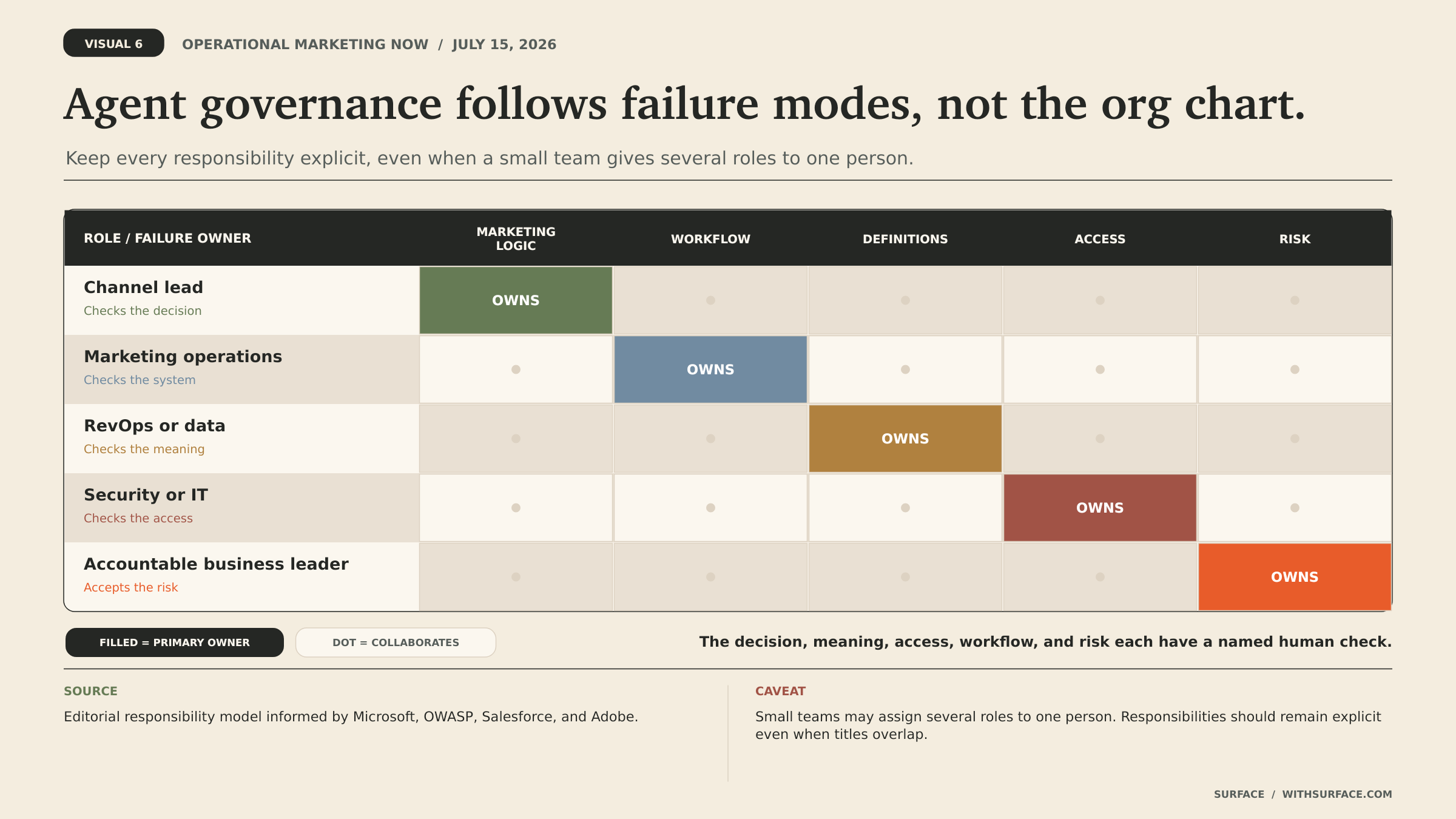
No single owner can evaluate every part of an agentic marketing workflow. Assign roles according to the failures each group can detect.
| Role | Owns | Key review question |
|---|---|---|
| Channel or functional lead | Marketing logic and recommendation quality | Would a competent specialist make this decision from this evidence? |
| Marketing operations | Workflow design, repeatability, and change control | Does the process behave consistently and fail visibly? |
| RevOps or data owner | Business definitions, joins, CRM consequences | Are identity, stages, timestamps, and revenue fields correct? |
| Security or IT | Credentials, scopes, vendor risk, retention, revocation | Does the agent have the minimum access, and can we remove it quickly? |
| Accountable business leader | Risk tolerance and outcome | Is the expected value worth the error cost and blast radius? |
The roles can live in a small company. The separation still matters. A founder may wear three hats and should consciously switch between them. Teams already formalizing lead operations have an advantage because they are accustomed to assigning ownership across marketing, systems, and sales.
Approval gates need explicit triggers
An approval policy should name the condition, reviewer, evidence required, expiration, and rollback path. "Human review required" is too vague. A useful rule might say that any weekly budget reallocation above $2,000 or 10% of campaign spend requires the acquisition lead to review source data, tracking health, and the proposed change within four hours. If approval expires, the agent does nothing.
Use stricter gates for irreversible, public, regulated, or customer-facing actions. Publishing a product claim, changing consent fields, modifying lead status, and sending an email deserve different reviewers. A workflow that improves inbound lead management can draft a routing correction while leaving the CRM write to RevOps until its exception rate is understood.
Microsoft's preview MCP server certification asks for verified publishers, authentication readiness, complete documentation, tested tools, and evidence when available. Buyers can borrow that structure even when a server is not in Microsoft's ecosystem. Ask the vendor for tool definitions, permission scopes, test results, data handling, support ownership, and change notices.
 ## Logs should reconstruct the decision
Traditional application logs may show that a tool call succeeded. A marketing audit needs more context. Preserve the requesting user or service identity, model and workflow version, instruction version, data sources, query time, returned record identifiers, material calculations, recommendation, approval decision, executed action, and verification result.
Do not store sensitive prompts or customer data indefinitely because logging can create its own exposure. Define retention by workflow and legal need. Redact or tokenize sensitive fields where the audit does not require the raw value. Make the log searchable by account, campaign, record, action, and approver.
The OWASP MCP Security Cheat Sheet recommends least privilege, explicit authorization, input validation, secure credential handling, and monitoring. Marketing leaders do not need to become security engineers. They do need to ensure that campaign urgency does not bypass ordinary access controls.
Evaluate behavior before expanding scope
Create a test set for each material workflow. Include normal cases, incomplete data, conflicting sources, an unauthorized request, a stale credential, and a prompt that tries to redirect the agent away from its task. Score retrieval, definition use, source coverage, unsupported claims, permission handling, and action selection.
Run the test after model, prompt, server, schema, or business-rule changes. An agent is a versioned operating system, not a one-time automation. Adobe and Salesforce describe broad systems spanning content, activation, data, and measurement. The broader the system becomes, the more useful a shared integration layer and visible change control become.
Prepare the incident path before the first write
Name the person who can disable the workflow. Document how to revoke the credential, stop pending actions, identify affected records, restore prior state, notify stakeholders, and preserve evidence. Test the path once. A kill switch no one has used is an assumption.
A lead operations system that connects capture, qualification, and routing can give operators useful shared context. Governance protects that context from becoming ambient authority. The agent should know enough to help and possess only enough access to complete the approved job.
The strongest governance program will feel ordinary. Permissions match roles. Recommendations show evidence. Approval is a real decision. Logs can reconstruct what happened. When the agent becomes more capable, the team expands authority deliberately rather than discovering its reach during an incident.
Practical steps
- Create an authority map for every connected tool, object, action, credential, and owner.
- Assign the five permission tiers independently and review them quarterly.
- Write approval rules with numeric or event-based triggers, evidence requirements, and expiration behavior.
- Log enough context to reconstruct the recommendation and action without retaining unnecessary sensitive data.
- Run evaluation cases after any model, server, schema, prompt, or business-rule change.
- Test credential revocation and rollback before enabling the first production write.